About this cultivar:
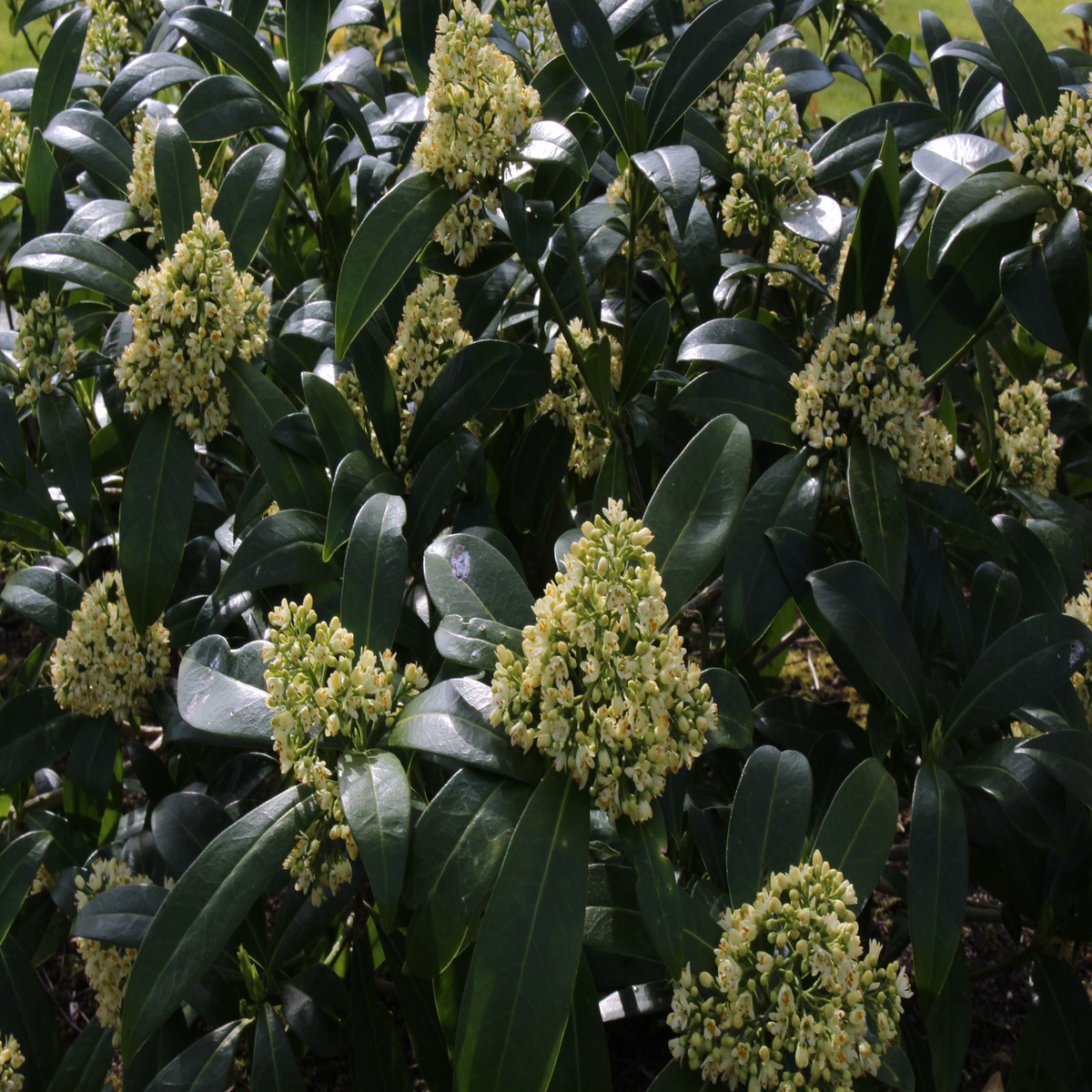
Skimmia x confusa ‘Kew Green’ (m) is a small, dome shaped, spreading evergreen shrub with glossy, aromatic, leaves. It also has large clusters of fragrant greenish-yellow flowerheads in autumn and winter with flowers in spring. It is the result of a cross between Skimmia anquetilia and Skimmia japonica and has the Royal Horticultural Society Award of Garden Merit. Possibly the best garden Skimmia.
I have seen folk call it female, as far as I (and the RHS) know It is a male (m) plant! Never seen any berries!
- Position: Full sun, partial shade
- Soil: Almost any soil, grows well in Ballyrobert
- Flowers: May, June, July
- Other features: Grows well in Ballyrobert, Royal Horticultural Society Award of Garden Merit (RHS AGM)
- Hardiness: H5 – Hardy in most places throughout the UK even in severe winters (-15 to -10C), Fully hardy, grows well in Ballyrobert
- Habit: Bushy
- Foliage: Evergreen
- Height: 60 – 100 cm (2 – 3.3 ft)
- Spread: 105 – 150 cm (3.5 – 5 ft)
- Time to full growth: 10 to 20 years
- Plant type: Shrub
- Colour: Green, white, yellow
- Goes well with: –
About this genus:
Skimmia is a genus of four species of evergreen shrubs and small trees in the Rue family, (Rutaceae), all native to warm temperate regions of Asia. First described by Carl Thunberg in Flora Japonica’, his 1784 record of plants which he collected in Japan in 1775-1776. The genus name was created from ‘Miyama shikimi, the Japanese name for Skimmia. The first recording of Skimmia in Europe was in 1838 at Kew Gardens.
All parts of the plant have a pungent aroma when crushed, the smell is usually citrussy since most citrus are also in the Rue family. The leaves are, evergreen, simple, lanceolate, with a smooth margin and usually clustered at the ends of the shoots. In spring the flowers are born in dense panicle clusters and vary from white to pink to purple. The fruit is red to black, fleshy, containing a single seed. Both a male and female plant is needed in order to get berries. The pollen from male flowers fertilises the female flowers, resulting in berries on the female plant only (it was not until Dr Masters published his study of the skimmias in 1889 that this came to be generally realised in the West!).
Growing them anywhere outside a desert or swamp is easy. They tend to have a very tidy habit and are quite slow growing, so minimal pruning and shaping is needed. You may read some of them dont like wet feet, we dont grow them here, so dont sell them here, so dont worry!
In the garden the attraction can vary depending on what Skimmia you have! Some folk grow them for the berries but, as weve seen, that may be complicated. The flower heads provide a lovely sight for a long time as the buds appear in autumn, last through winter and open in the spring. Of course, being evergreen the foliage is also of interest and gives an exotic (Japanese), traditional (it is like holly), or architectural (tidy habit) feel wherever you plant it. We find it is one of those plant that never seem out of place, so if you like the look of it, go for it

 -20%