About this cultivar:
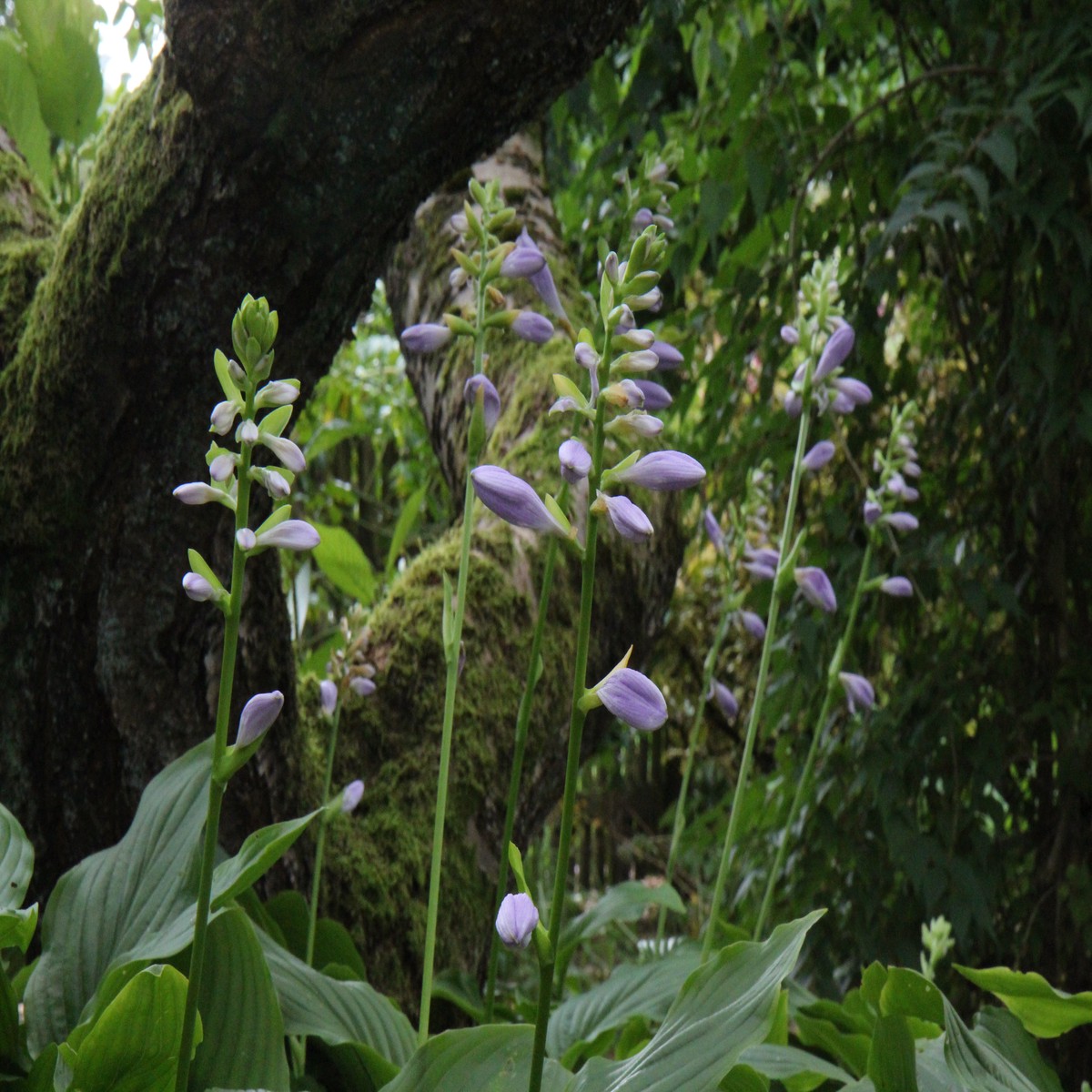
Hosta ‘Honeybells’is one of the classic hostas that was originated in 1952 as a, possible, hybrid of Hosta plantaginea and Hosta lanceolata. This cultivar was registered by The American Hosta Society on behalf of the originator, Connecticut nurseryman, Alex Cumming, in 1986.
This fast growing mound has wavy, smooth textured foliage. The leaves are oblong-elliptic and have average substance. The photo of the clump here has something wrong with the colour, it is a darker green like in the flower-photos!
It has fragrant flowers inlate summer, which unusually for Hostas, are quite appealling.It happily tolerates full sun, which brings out the elusive fragrance of the flowers.
- Position:Full sun, partial shade, full shade
- Soil:Almost any soil,grows well in Ballyrobert
- Flowers: June, July
- Other features:Royal Horticultural Society Award of Garden Merit (RHS AGM),Grows well in Ballyrobert, Interesting Foliage or Fruit, Dappled Shade or Full Shade Loving
- Hardiness:Fully hardy – grows well in Ballyrobert, H7- Hardy in the severest European continental climates (< -20C)
- Habit: Clump forming
- Foliage:Deciduous
- Height:30 – 45 cm (1 – 1.5 ft)
- Spread:45 – 90 cm (1.5 – 3 ft)
- Time to full growth:2 to 5 years
- Plant type: Herbaceous Perennial
- Colour: Green, white
- Goes well with:Cornus, ferns, allium
About this genus:
Hosta (hos-ta) is a genus of plants commonly known as plantain lilies,giboshi,or the old botanical nameFunkia.The name Hosta is in honor of the Austrian botanist Nicholas Thomas Host. Howevermost modern plants were introduced from Japan to Europe by Philipp Franz von Siebold in the mid-19th century. Don’t worry about Philipp’s legacy being forgottenthough; he has a species named after him! (Hosta sieboldiana).
Hostaare often touted as the best shade-loving plants for the perennial garden, which is hard to dispute. In cultivation, Hostareadily mutate and have produced thousands of novel colours and leaf forms (blue, gold, and variegatedare the most popular). Because of their great foliageHosta are often thought of as foliage-only plants, but it is worth noting that many cultivars have fantastic flowers – see “Sum and Substance” and “Stained Glass” for example.
You will read that for best performance, Hostaprefer to be out of full-sun. However if you live on these islands it is doubtful you will ever get any full-sun; so you may try them in your brightest spot as long as they have some moisture.You may have had some experience with slugs and Hosta. So have we. We have found that cultivars matter (some are tastier to slugs than others) so we try to grow only slug resistant cultivars or ones that grow so many new leaves the slugs can’t keep up. We’ve also found that, by not using chemicals, little mites that eat slugs eggs multiply and keep the population down – let nature run its course! Some slug-loving-predator should turn up eventually!
How to use Hosta? Well,if you are paranoid aboutslugs, place the plant inthe middle or back of the border where you can only see the upper part of the plant. Slugs don’t climb so high so the lower leaves that get slug damaged won’t be seen! As for plant partners we put some red stemmed dog-woods near or through them (Cornus), or large leaf-ferns. It is common to put bulbs in and aroundHostas; we do it withAllium. But we don’t do itwith Narcissi or Tulipa; they don’t like the competition.

 -20%